Destination Details
Norway
Explore culture, nature, local stories on calm routes crafted for meaningful regional travel
Discover Norway
Norway is a country sculpted by ice and time, where deep fjords cut into mountain ranges and fishing villages cling to rocky shores beneath towering peaks. The landscape here operates on a scale that makes human presence feel both small and privileged. From the cosmopolitan warmth of Oslo to the Arctic wilderness of the Lofoten Islands, Norway rewards travelers who are willing to embrace its dramatic contrasts of light and season.
Experiences That Define the Journey
Sailing through the fjords is Norway's defining experience. The Geirangerfjord, a UNESCO World Heritage Site, narrows between sheer cliff walls where waterfalls cascade from snow-capped heights directly into deep blue water. The silence between the falling water is profound, broken only by the cry of sea eagles circling overhead. The Sognefjord, Norway's longest and deepest, stretches over two hundred kilometers inland, connecting coastal communities to mountain villages accessible only by boat or foot.
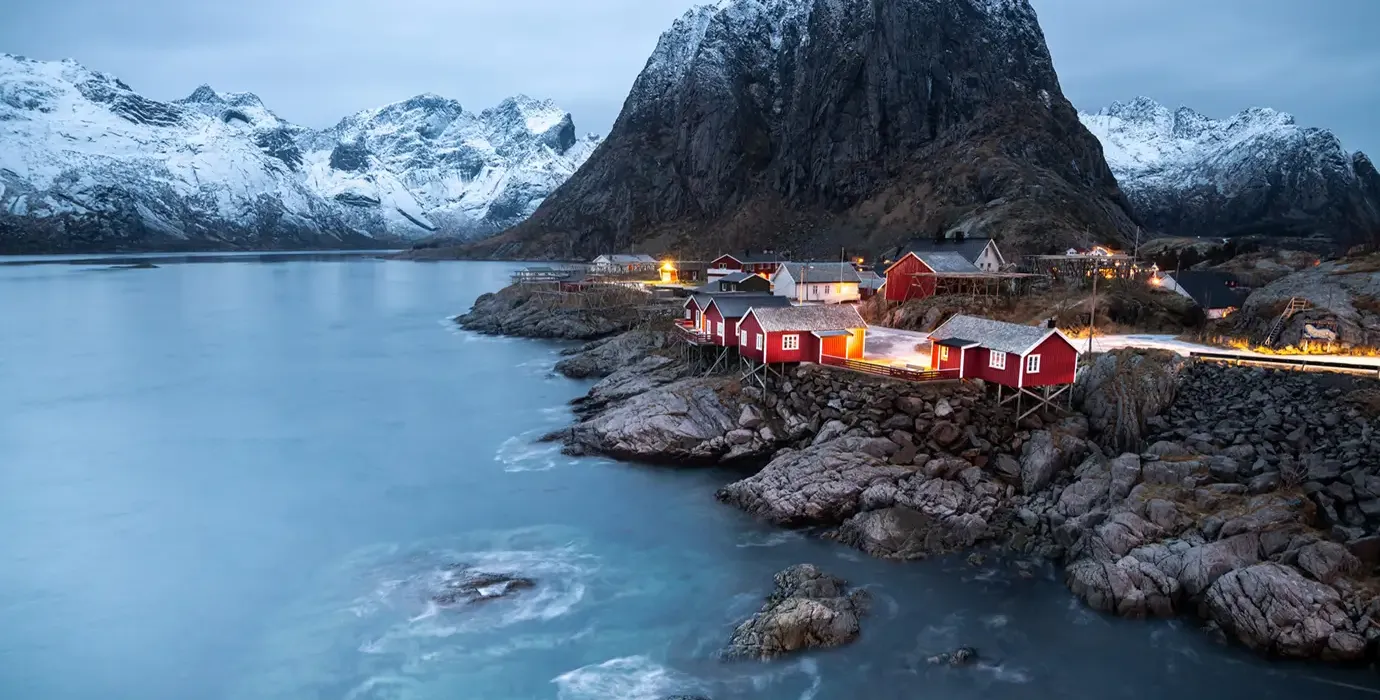
In the Lofoten Islands, above the Arctic Circle, jagged peaks rise dramatically from the Norwegian Sea. Fishing villages with red wooden cabins, called rorbuer, dot the shoreline. In winter, the northern lights dance above these islands with an intensity found few other places on earth. In summer, the midnight sun allows for hiking, kayaking, and fishing at any hour of the endless day.
Culture and Traditions
Norwegian culture is rooted in a deep respect for nature and a tradition of outdoor life called friluftsliv. This philosophy, which translates roughly as open-air living, shapes everything from weekend habits to urban planning. Oslo's opera house, designed to resemble a glacier, invites visitors to walk on its roof and gaze across the fjord. Bergen, the gateway to the fjords, preserves its Hanseatic trading heritage in the colorful wooden warehouses of Bryggen, now filled with artisan shops and restaurants.
Practical Tips
- Best time to visit: May to September for fjords and hiking, November to February for northern lights
- Getting around: The Flam Railway and Hurtigruten coastal ferry are iconic Norwegian journeys
- Budget tip: The Norway in a Nutshell pass combines trains, buses, and ferries at a fixed price
- Weather note: Dress in layers and always carry rain gear, even in summer
- What to pack: Waterproof hiking boots, merino wool base layers, binoculars, and a headlamp for winter
Norway does not rush. The fjords took millions of years to form, and they ask you to slow down in return. Stand at the edge of a cliff above Geirangerfjord and you will understand why the Vikings believed their gods lived in places like this.
Nearby Highlights
The Trolltunga rock formation, a narrow ledge jutting horizontally over a lake seven hundred meters below, is one of Norway's most photographed natural features. The Preikestolen, or Pulpit Rock, offers a flat-topped cliff overlooking the Lysefjord that draws hikers from around the world. Further north, Tromso serves as the capital of Arctic Norway, with excellent museums, a striking Arctic Cathedral, and some of the best northern lights viewing on the continent.
Available Package:


Gallery: